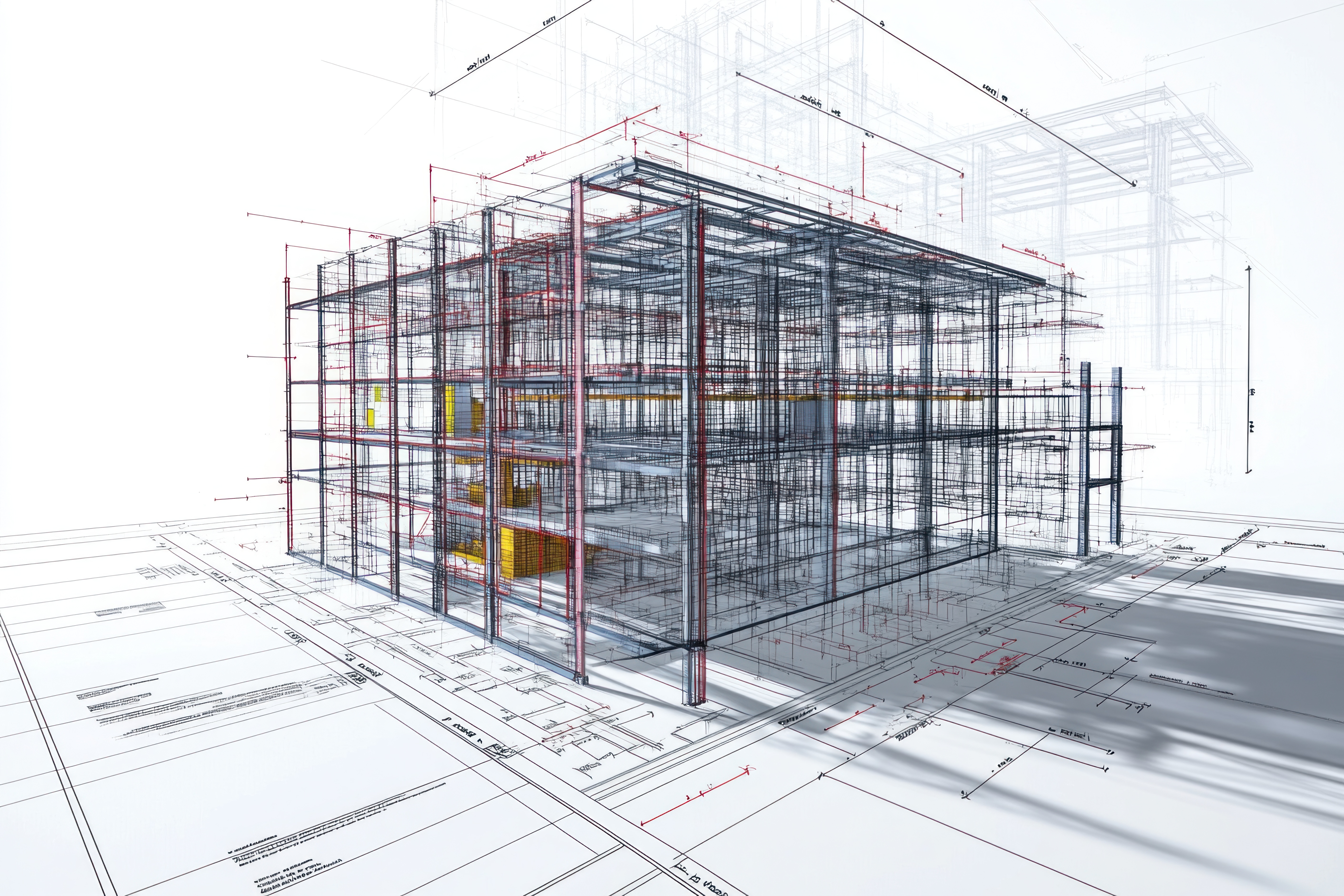
Precision Spatial
Modeling.
Browser-native 2D/3D spatial editor with photorealistic 3D reconstruction from standard mobile video. No software installation required.
Spatial Documentation Without the Overhead
Spatial documentation has traditionally required specialized hardware, expensive software licenses, and trained operators. A building assessment means dispatching a crew with laser scanners and spending days processing point clouds. A facility inventory means CAD licenses, training, and file format headaches that never end.
Speculum eliminates these barriers. The 2D spatial editor runs entirely in the browser — snapping grids, auto-dimensioning, precision measurement tools — with zero installation. For 3D reconstruction, a standard mobile phone video is processed through a structure-from-motion pipeline into a Gaussian splatting model that produces centimeter-accurate, photorealistic spatial documentation.
The result is spatial documentation that anyone can create and anyone can view, running on dedicated GPU infrastructure rather than shared cloud instances. Over 5,000 PBR material textures enable photorealistic visualization, while AI-powered surface segmentation automatically identifies and classifies materials within captured spaces.
Phone Video to 3D Model in Four Stages
No laser scanners. No specialized hardware. Standard mobile video in, photorealistic spatial model out.
Technical Capabilities
Seven subsystems spanning 2D editing, 3D reconstruction, and material intelligence. Each independently deployable.
Browser-Based Spatial Editor
Full-featured 2D spatial editor running entirely in the browser. Snapping grid with configurable intervals, automatic dimensioning as walls and boundaries are drawn, and precision measurement tools for area and distance calculations. No plugins, no downloads, no CAD license required.
3D Reconstruction Pipeline
End-to-end photogrammetry pipeline: structure-from-motion extracts camera positions and sparse geometry from video frames, then Gaussian splatting produces a compressed, photorealistic 3D model. Output viewable in-browser with real-time navigation.
High-Precision Measurements
Spatial measurements derived from mobile video capture calibrated through known reference dimensions and multi-view geometry. Produces measurements suitable for facility documentation, as-built verification, and compliance reporting without laser scanning equipment.
5,000+ PBR Material Textures
Physically-based rendering material library — wood, concrete, metal, fabric, stone, tile, and specialty materials. Applied to spatial models for photorealistic visualization that communicates spatial intent to non-technical stakeholders. Materials respond to lighting conditions accurately.
AI-Powered Surface Segmentation
Machine learning models automatically segment captured spaces into material categories — identifying wall surfaces, flooring types, ceiling materials, fixtures, and structural elements. Accelerates material takeoff for damage assessment and facility condition reporting.
Dedicated GPU Infrastructure
3D reconstruction runs on dedicated GPU instances — not shared cloud compute that throttles under load. Predictable processing times, consistent quality, and no queue contention with other tenants. Infrastructure scales vertically per job for maximum throughput.
Five processing layers, each independently scalable. Spatial data enters at the top, interactive 3D models exit at the bottom.
External system connections via standard protocols. Each integration is independently configurable and monitored.
| Category | Technology |
|---|---|
| 3D Engine | Three.js + WebGL 2.0 |
| Reconstruction | Structure-from-Motion pipeline |
| Rendering | Gaussian Splatting (real-time) |
| Mapping | Mapbox GL JS integration |
| Output | glTF, OBJ, IFC, DXF, LAS |
| Measurements | Browser-native distance, area, volume |
| Hosting | US-based CDN, edge-cached delivery |
Speculum spatial models integrate with Verdandi for geographic intelligence correlation, IRONWRAITH for AI-assisted facility analysis, and SILTWIRE for field team coordination. Threat assessments flow through HELL HOUND, communications through TESSERA, and all platform infrastructure is built on FORGE architecture.
9,600+ Federal Buildings Need Spatial Documentation
GSA manages over 9,600 federal buildings across the United States — courthouses, office complexes, land ports of entry, laboratories, and data centers. Many lack current spatial documentation. Floor plans are outdated or nonexistent. As-built conditions diverge from original drawings by decades of modifications.
Speculum enables rapid spatial documentation of these facilities at a fraction of traditional surveying costs. A single operator with a mobile phone can capture a building's spatial reality in hours rather than weeks. The output integrates directly with facility management systems, space utilization tools, and emergency planning platforms.
Applicable Domains
Speculum adapts to any domain where physical spaces need to be measured, documented, and visualized.
Discuss Spatial Capabilities
Architecture review with the engineers who built it. No sales deck. No demo theater.